

How to Boost Visibility in AI-Generated Responses and Search Engines
Generative Engine Optimization (GEO) is the practice of structuring your website’s content, technical signals, and off-site reputation so that AI systems — ChatGPT, Perplexity, Claude, Gemini, and Google AI Overviews — retrieve, trust, and cite your business when they generate answers. Where traditional SEO earns rankings and clicks, GEO earns mentions and citations inside the answer itself.
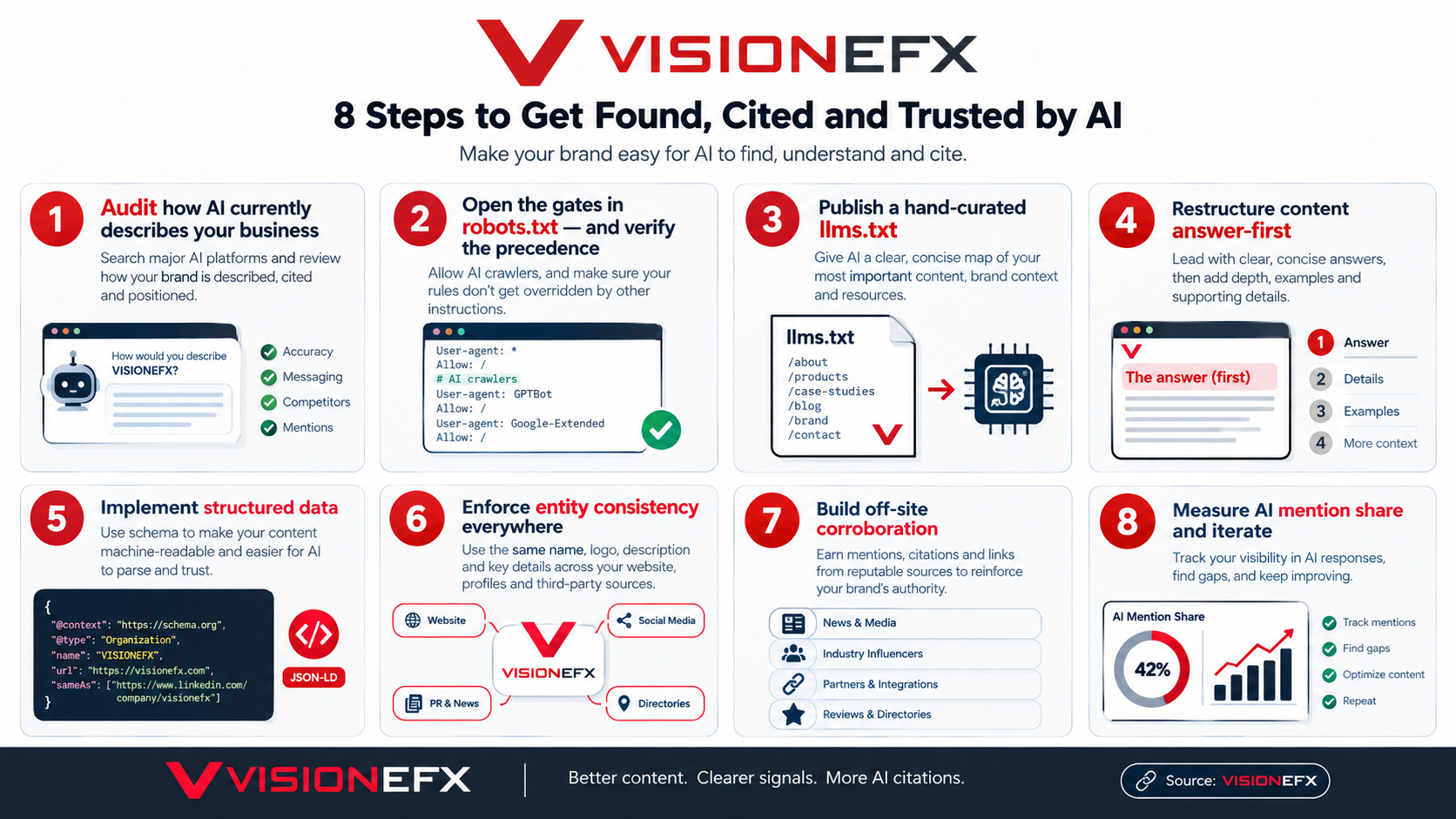
The techniques that move the needle, in one list:
– Open your site to AI crawlers — GPTBot, OAI-SearchBot, PerplexityBot, ClaudeBot — with a correctly ordered robots.txt.
– Publish a hand-curated llms.txt that maps your most citable pages by intent.
– Restructure content answer-first: question-phrased headings, self-contained 40–80 word answers, tables and FAQ blocks that machines can lift cleanly.
– Implement structured data — Organization, Service, FAQPage, HowTo, and named authors — so your claims are machine-readable.
– Enforce entity consistency: identical business facts across your site, Google Business Profile, Bing Places, and directories.
– Build off-site corroboration: reviews, third-party mentions, and comparison content that AI models treat as consensus.
– Measure AI mention share, not just rankings, and iterate.
The rest of this guide explains why these work and exactly how to execute them — from an agency that has been building findable websites since 2000 and applies every one of these techniques on its own site and a working roster of client sites.
How AI Engines Decide What to Cite
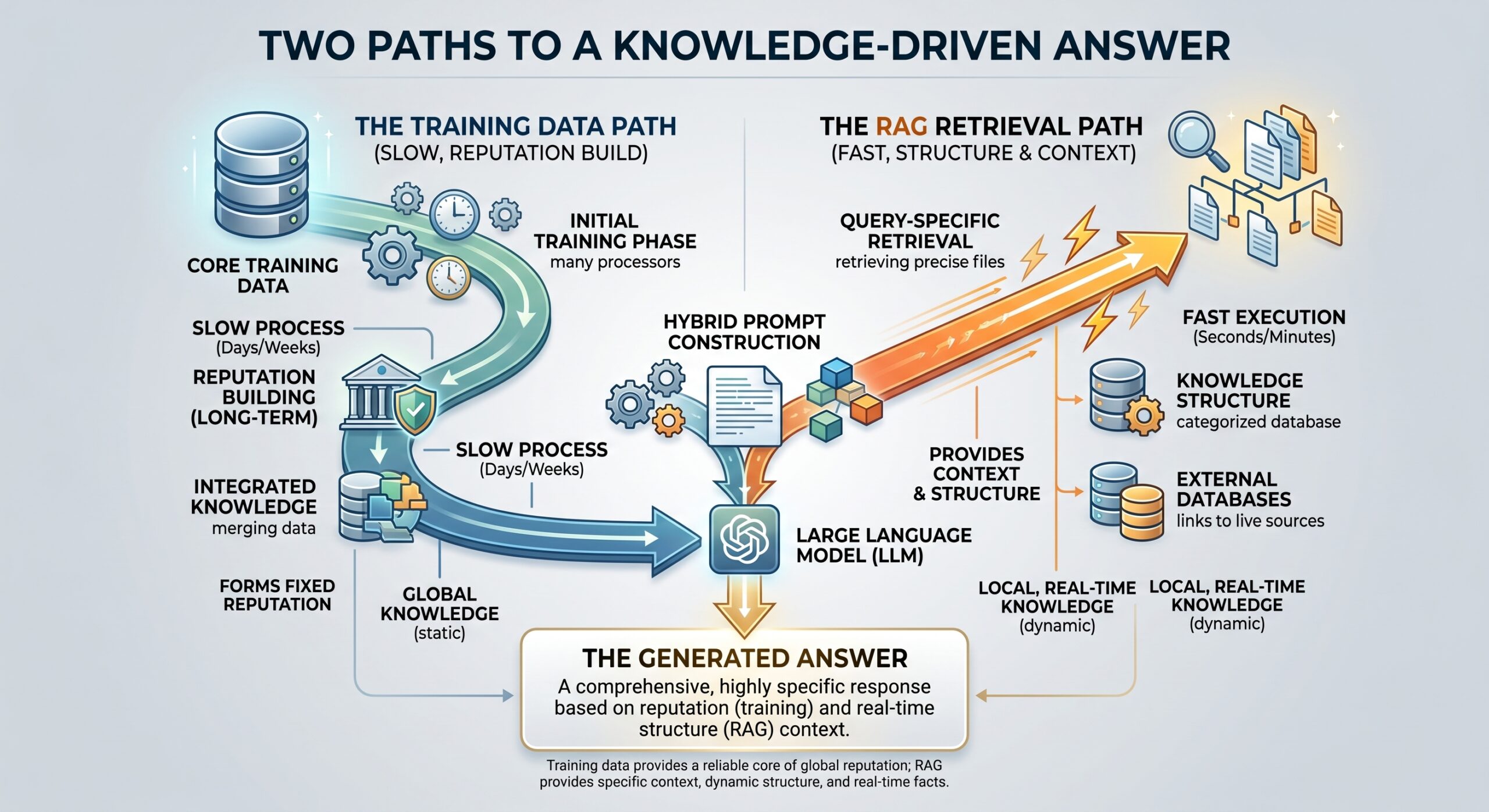
To optimize for AI answers, you need to know where those answers come from. There are two sources, and they reward different work:
1. Training data (what the model “knows”). Large language models absorb the public web during training. Your brand’s presence in that data — consistent facts, third-party mentions, reviews — shapes what the model says about you from memory. This moves slowly and rewards long-term reputation.
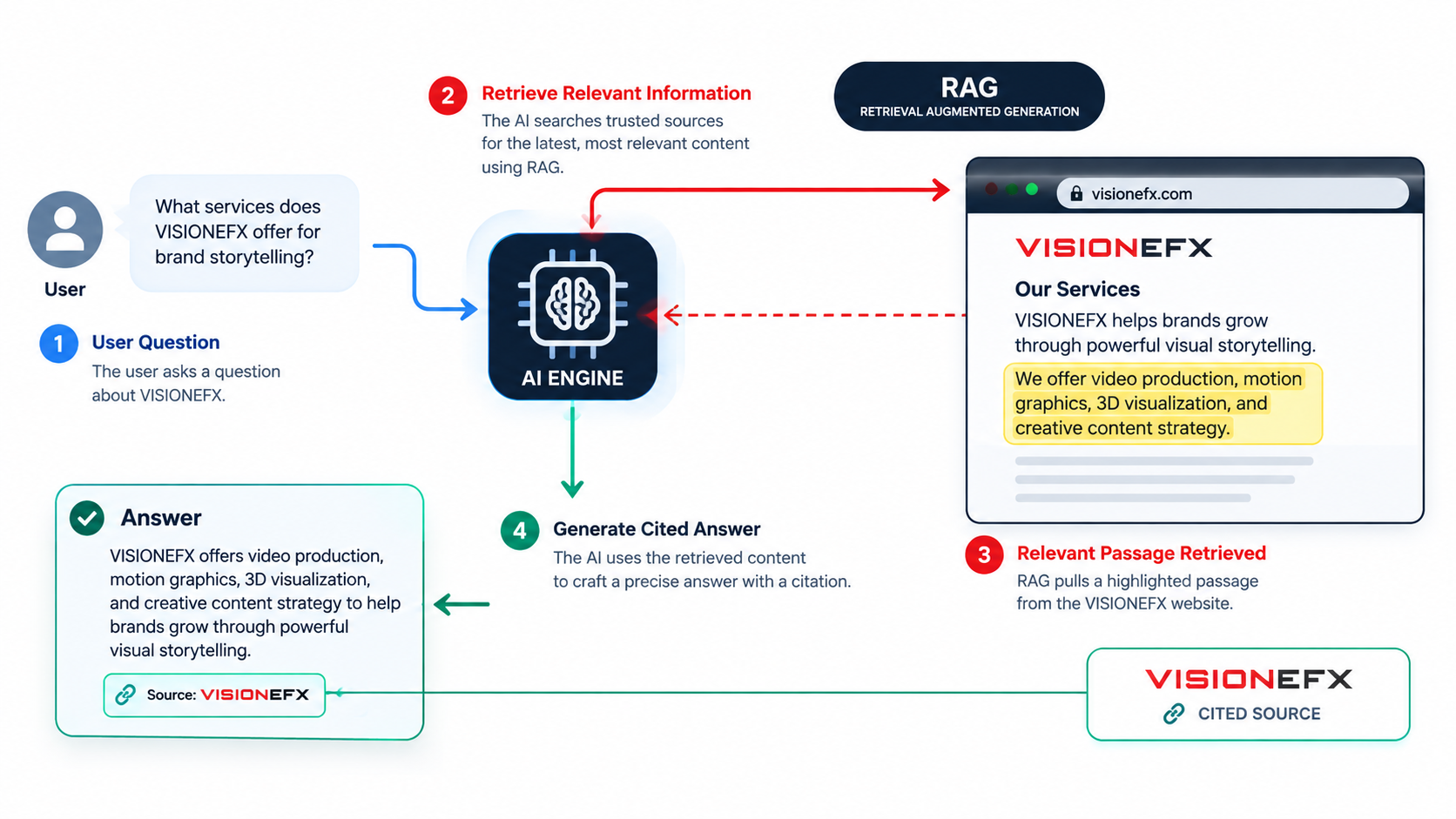
2. RAG — Retrieval-Augmented Generation (what the model looks up). When you ask ChatGPT, Perplexity, Copilot, or Google’s AI Overviews a question, the engine typically runs live searches, retrieves relevant pages, and synthesizes an answer with citations. This is where most near-term GEO opportunity lives — and it’s why GEO sits *on top of* SEO rather than replacing it: RAG retrieves from search indexes. ChatGPT and Copilot lean heavily on Bing’s index; AI Overviews and Gemini draw on Google’s. If you rank nowhere, there’s nothing to retrieve. (This is also why we actively maintain clients’ Bing Places listings — an index most agencies still ignore.)
Layer on zero-click search behavior: a growing share of searches now end inside an AI-driven summary, with no visit to any website. You can’t fully opt out of that shift — but you can decide whether the summary names your business or your competitor’s. In a zero-click answer, the citation is the click. That reframes the KPI: alongside rankings and traffic, you track AI mention share — how often, how prominently, and how accurately AI engines name you for the prompts your customers ask.
One more mechanical detail that shapes everything below: retrieval works at the passage level. AI systems don’t cite your homepage; they lift the specific chunk of text that answers the question. A page of vague marketing prose gives them nothing to lift. A page of self-contained, factual, well-labeled answers gives them a dozen citable passages.
The GEO Playbook: 8 Steps to Get Cited by AI Engines
Step 1: Audit how AI currently describes your business
Ask ChatGPT, Perplexity, Gemini, and Claude the questions your customers ask: “best [your service] in [your city],” “who is [your company],” “[your company] vs [competitor].” Record whether you’re mentioned, in what position, and whether the facts are right. Wrong facts in AI answers usually trace back to inconsistencies you control.
Step 2: Open the gates in robots.txt — and verify the precedence
Confirm your robots.txt allows the AI crawlers that matter: **GPTBot** and **OAI-SearchBot** (OpenAI), **PerplexityBot**, **ClaudeBot** (Anthropic), and decide deliberately on **Google-Extended**. Then verify the file actually does what you think: robots.txt follows group-precedence rules, and one misordered user-agent block can silently shut out every AI crawler while your Google traffic looks perfectly healthy. We found exactly that class of bug on our own site during our redesign — which is why this step is second, not last.
Step 3: Publish a hand-curated llms.txt
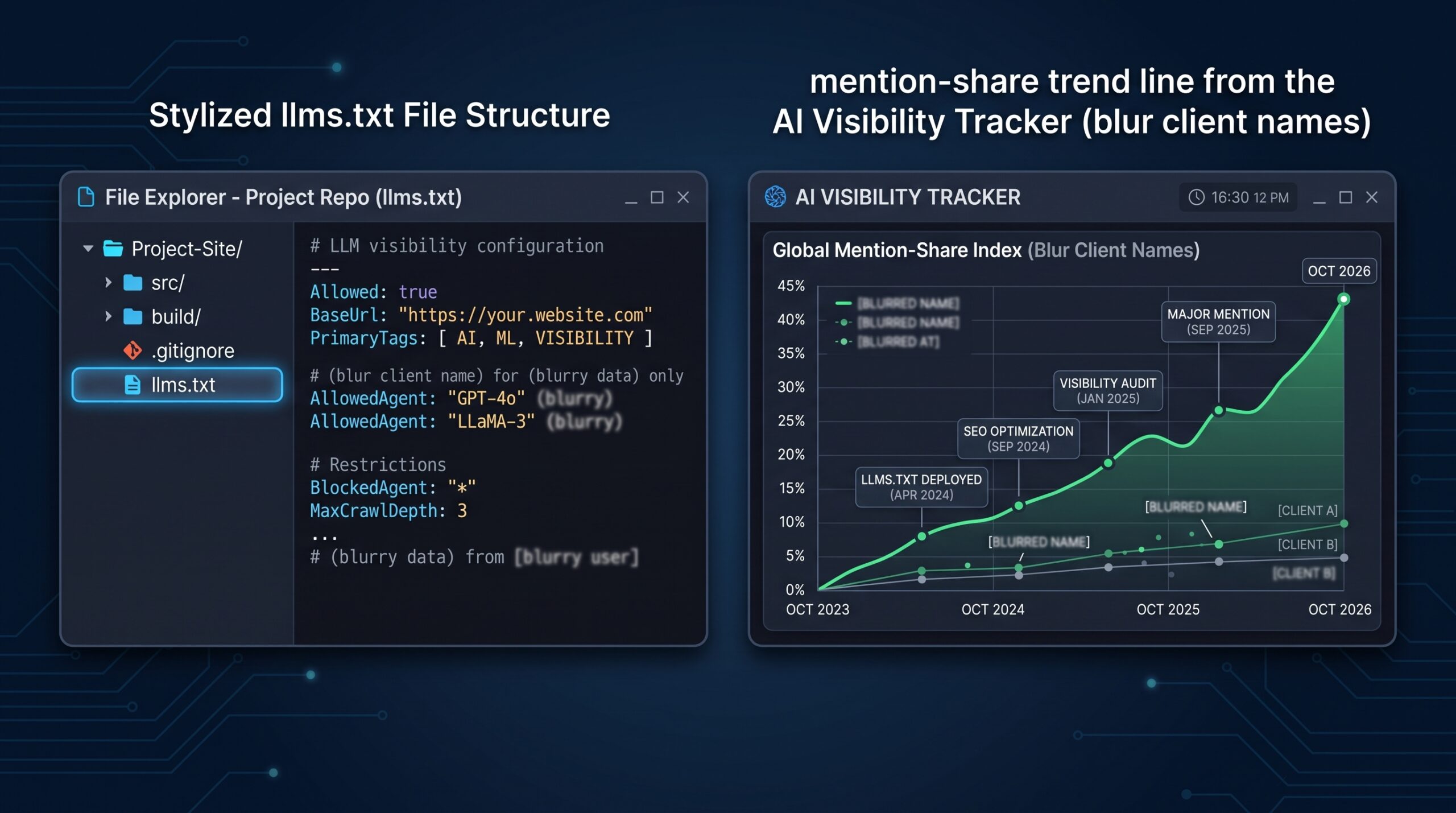
llms.txt is a plain-text map at your domain root that tells AI systems which pages matter and why. Skip the auto-generated versions — a dump of every URL is noise. Curate it by intent: services, locations, pricing, proof, FAQs. Ours is a 124-link, spec-compliant document organized by service intent, and every URL in it is verified to resolve — a dead link in llms.txt is an invitation to cite a 404.
Step 4: Restructure content answer-first
Rewrite key pages so each section can stand alone as a citation: headings phrased as the questions users ask, a direct 40–80 word answer immediately under each heading, then supporting depth. Add comparison tables, definition sentences, and FAQ blocks. If a passage can’t be lifted out of the page and still make sense — who, what, where, how much — it won’t be.
Step 5: Implement structured data
Add JSON-LD markup that makes your claims machine-readable: Organization/LocalBusiness (with founding date, address, sameAs links), Service, FAQPage, HowTo for instructional content, and Article with a named author. Note that Google dropped FAQ rich-result display for most sites in 2023 — but the markup still feeds parsers and retrieval systems, which is exactly the audience GEO targets.
Step 6: Enforce entity consistency everywhere
AI systems cross-check. Your business name, address, phone, founding year, services, and service area must match across your website, Google Business Profile, Bing Places, directories, and social profiles. Every contradiction lowers a model’s confidence in citing you; every corroboration raises it. Pick one version of every fact and enforce it ruthlessly.
Step 7: Build off-site corroboration
Models weight consensus. Earn reviews on major platforms, get included in third-party roundups and local press, publish comparison content, and maintain presence in the communities where your customers ask questions. A claim that exists only on your own website is an assertion; the same claim echoed across independent sources becomes a fact AI engines repeat.
Step 8: Measure AI mention share and iterate
Track a fixed panel of customer-realistic prompts across engines on a schedule, log whether you’re mentioned and how accurately, and watch the trend after each change. Check server logs to confirm AI crawlers are actually fetching your pages. Rankings tell you about Google; mention share tells you about the answer layer where your customers increasingly are.
What This Looks Like in Practice
Everything above is deployed work, not theory. Three examples from our own operation:
Our own site, first. The visionefx.net redesign shipped with the full GEO stack: the hand-curated 124-link llms.txt, a robots.txt audit that caught a group-precedence bug silently affecting crawler access, explicit OAI-SearchBot provisions, full redirect mapping, consolidation of duplicate flagship pages, and an architecture of dedicated service and location pages — 144 city pages across six states — each built as a self-contained, citable answer. An agency selling GEO should be able to say “view source.”
Client rollout. We’re applying the same spec-compliant llms.txt methodology across client sites — including long-term client BAY Crawl Space & Foundation Repair, a Hampton Roads home-services company — paired with an automated checker we built that verifies every URL in the file resolves before it ships. Curation plus verification is the difference between an llms.txt that guides AI crawlers and one that misleads them.
Measurement, in-house. Because no AI platform publishes a “popular searches” report, we built our own AI Visibility Tracker: it runs scheduled, customer-realistic prompt panels against the Perplexity, OpenAI, and Gemini APIs and logs mention share for every client on our roster, week over week. When we say a GEO change worked, that claim comes with a trend line.
That’s the expertise behind this guide: VISIONEFX has built websites since 2000 — 25+ years of web development across contractors, industrial firms, and professional services, with 150+ five-star Google reviews — and we treat AI visibility the way we’ve always treated search: as an engineering discipline, measured and repeatable.
GEO and SEO at a Glance
| Traditional SEO | Generative Engine Optimization | |
|---|---|---|
| Goal | Rank in results pages | Be cited inside AI answers |
| Unit of success | Position + click | Mention + accurate citation |
| Optimizes for | Crawlers + ranking algorithms | Retrieval (RAG) + synthesis |
| Content shape | Keyword-targeted pages | Liftable, self-contained answers |
| Key files | robots.txt, sitemap.xml |
robots.txt, sitemap.xml, llms.txt |
| Measurement | Rankings, traffic, CTR | AI mention share, citation accuracy |
They’re not rivals: GEO depends on the crawlability, authority, and index presence that SEO builds. Do both or watch someone else get cited.
Frequently Asked Questions About GEO and AI Search Visibility
What is Generative Engine Optimization (GEO)?
Generative Engine Optimization (GEO) is the practice of structuring a website’s content, technical signals, and off-site reputation so AI systems like ChatGPT, Perplexity, Gemini, and Google AI Overviews retrieve, trust, and cite the business in their generated answers. It extends traditional SEO from earning rankings and clicks to earning mentions inside AI-driven summaries.
How is GEO different from SEO?
SEO optimizes for position on a results page; GEO optimizes for citation inside an AI-generated answer. GEO builds on SEO — AI engines retrieve from search indexes like Bing and Google — but adds AI-specific work: llms.txt files, AI crawler access, answer-first content structured for passage-level retrieval, entity consistency, and measuring AI mention share instead of only rankings.
What is RAG and why does it matter for my website?
RAG (Retrieval-Augmented Generation) is how most AI search tools build answers: the engine runs live searches, retrieves relevant web pages, and synthesizes a cited response. It matters because retrieval happens at the passage level — AI engines cite the specific chunk that answers the question — so websites with self-contained, factual, well-structured answers get cited, and vague pages get skipped.
What is llms.txt and does my business need one?
llms.txt is a plain-text file at your domain root that gives AI systems a curated, intent-organized map of your most important pages. Businesses that want AI visibility should publish one — hand-curated, not auto-generated — and verify every listed URL resolves. VISIONEFX maintains a 124-link spec-compliant llms.txt on its own site and builds them for client sites.
How do I get my business mentioned in ChatGPT and other AI answers?
Getting mentioned in ChatGPT requires being retrievable and trustworthy: allow OpenAI’s crawlers (GPTBot, OAI-SearchBot) in robots.txt, maintain strong Bing visibility since ChatGPT’s retrieval draws on Bing’s index, publish answer-first content with schema markup, keep business facts identical everywhere online, and build third-party corroboration through reviews and independent mentions.
How do you measure AI search visibility?
AI search visibility is measured as mention share: run a fixed panel of customer-realistic prompts across ChatGPT, Perplexity, and Gemini on a schedule, and log whether the business is mentioned, in what position, and with accurate facts. VISIONEFX built an in-house AI Visibility Tracker that automates this weekly across its client roster, alongside server-log checks confirming AI crawlers fetch each site.
Should I block AI crawlers from my website?
For most businesses, no — blocking AI crawlers removes you from the answer layer where a growing share of buying decisions start. Zero-click behavior means many customers never leave the AI summary, so exclusion doesn’t protect traffic; it forfeits the mention. The deliberate exception is gated or proprietary content, which can be excluded selectively while service pages stay open.
Get Cited, Not Just Ranked
If you’d like to know how AI engines currently describe your business — and what it would take to change the answer — request a GEO audit. We’ll run the prompt panel, check your crawler access and llms.txt, and show you the gaps, the same way we’ve engineered findability since 2000.